Sunday's Cathedral: The Vikings and the Stadium That Rebuilt a District
U.S. Bank Stadium's glass prow remade the east end of downtown along with the Vikings' Sundays. A decade into its life, the building's second job — district anchor — is the bigger story.
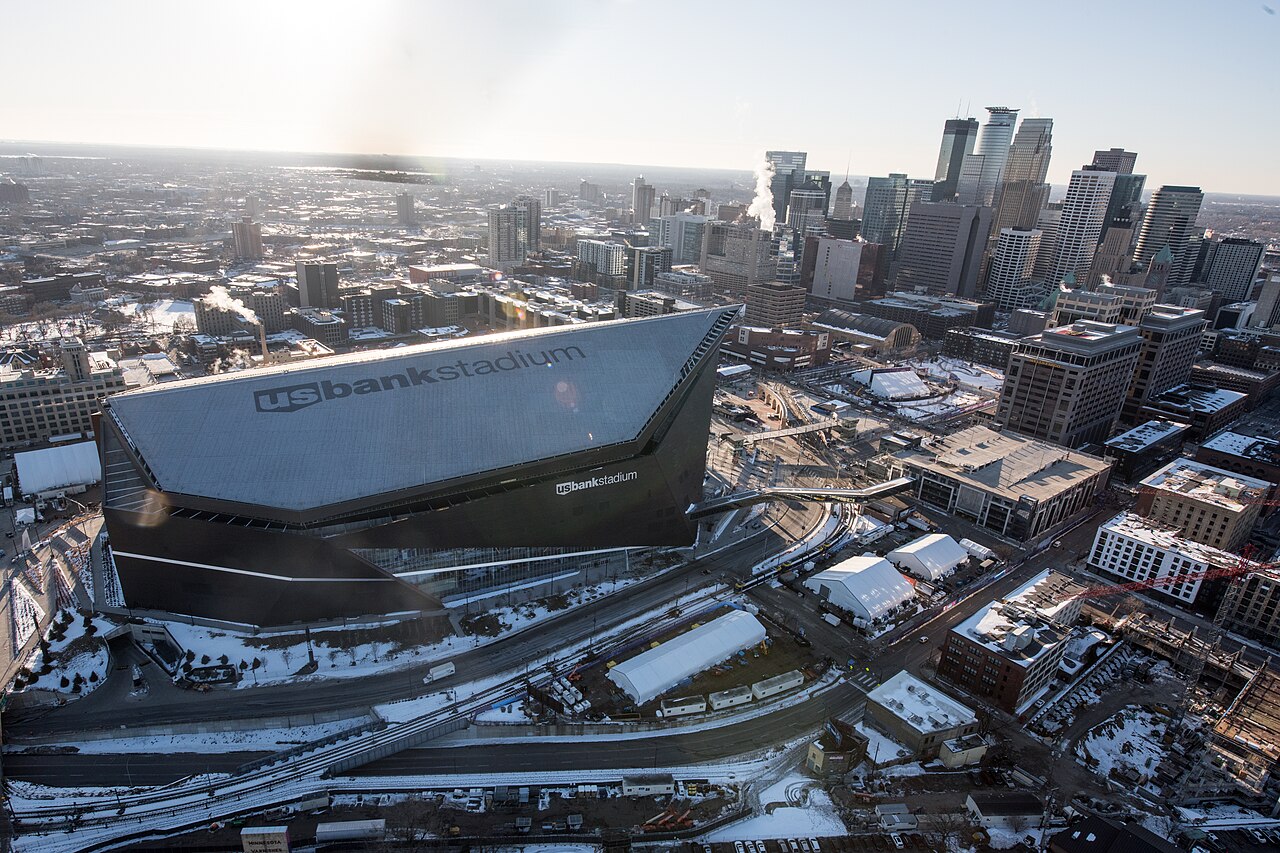
The first thing to understand about U.S. Bank Stadium is that it is not really a dome. The Vikings' home, opened in 2016 on the site of the old Metrodome, is a glass-and-zinc prow aimed at the downtown skyline, with the largest pivoting glass doors in the world at its west end and a translucent roof that fills the bowl with the gray Minnesota light its designers insisted on. On a November Sunday, snow can be falling on the roof while the field sits in shirtsleeve air — the building's whole argument in one image.
The football has justified the architecture often enough. The stadium seats 66,860 for Vikings games, expandable for the events it was also built to chase, and it has already hosted a Super Bowl, a men's Final Four and the X Games in its first decade — the event calendar the public financing debate promised, delivered on schedule. The Gjallarhorn sounds, the crowd does its skol chant, and the east end of downtown fills with the largest regular gathering in Minnesota life.
The district around it is the longer project. The stadium deal came with the Commons park on its front lawn, the redevelopment of the former Star Tribune blocks, light rail at its doorstep — the Blue and Green lines stop at U.S. Bank Stadium station — and a riverfront that now runs unbroken from the North Loop to the falls. East Town, as the neighborhood styles itself, was a district of parking lots within living memory. Game days were the plan to change that, and game days have largely worked.
The Vikings themselves remain the region's beautiful heartbreak, a franchise with four Super Bowl appearances in an earlier era and a modern history of seasons that end one game, one kick or one week too soon. November is when the current edition's truth arrives: the division race hardens, the home crowd's noise becomes a genuine tactical asset, and the building earns its nickname as the loudest room in the NFC North.
A stadium is a city's bet on its own future, made in concrete. Minneapolis made its bet on glass, light and a football team, and pointed the whole thing at the skyline so nobody would miss the point. On Sundays, nobody does.